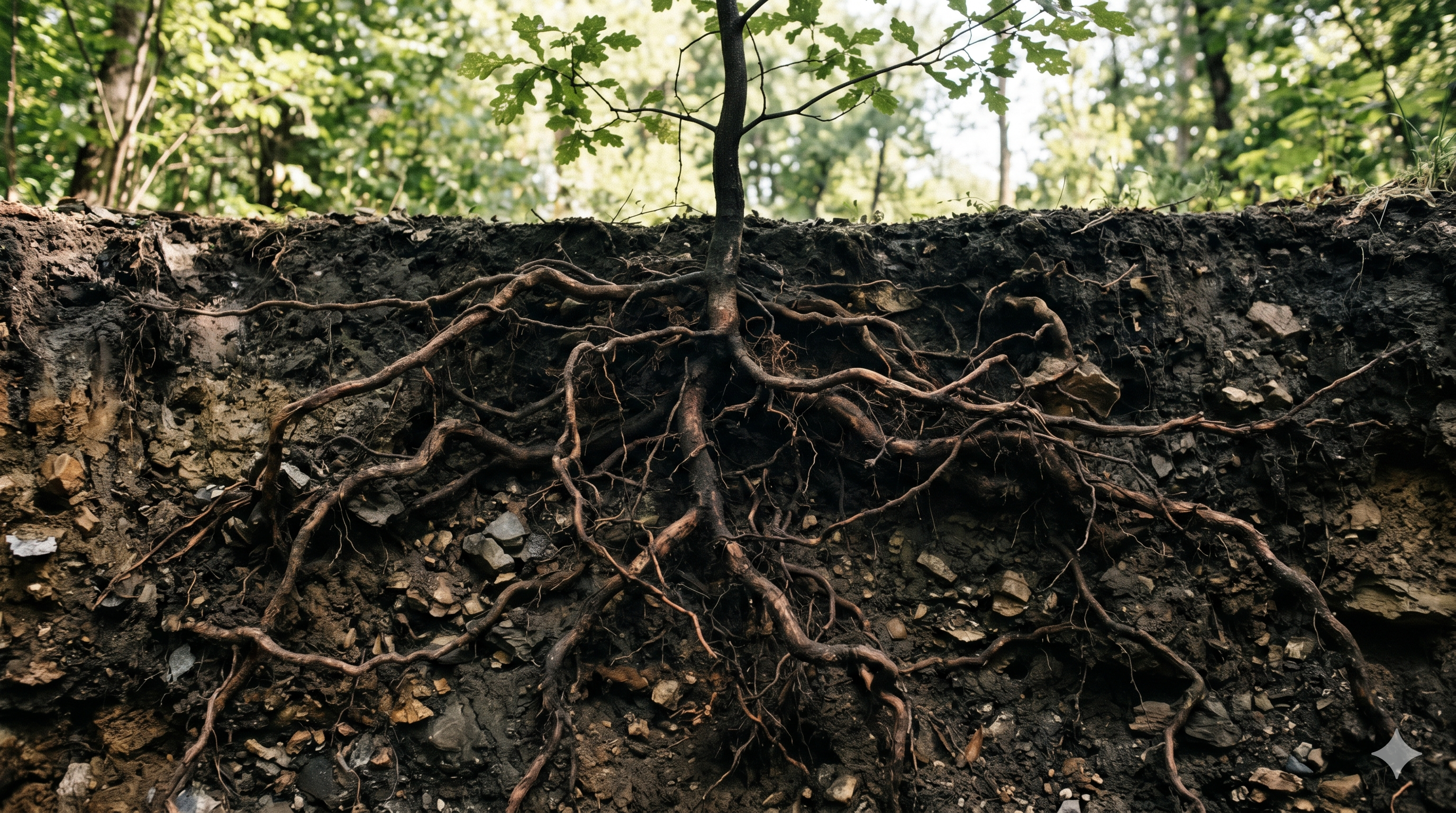
Recovery didn’t transplant me into a better life. It taught me how to grow where I’d already been planted — in the wreckage, in the dirt, in the exact spot I thought nothing could survive.
NEW SOIL . . . NEW ROOTS April 22
“Moments of perception can build into a lifetime of spiritual serenity, as I have excellent reason to know. Roots of reality, supplanting the neurotic underbrush, will hold fast despite the high winds of the forces which would destroy us, or which we would use to destroy ourselves.” — AS BILL SEES IT, p. 173
I came to A.A. green — a seedling quivering with exposed taproots. It was for survival but it was a beginning. I stretched, developed, twisted, but with the help of others, my spirit eventually burst up from the roots. I was free. I acted, withered, went inside, prayed, acted again, understood anew, as one moment of perception struck. Up from my roots, spirit-arms lengthened into strong, green shoots: high-springing servants stepping skyward. Here on earth God unconditionally continues the legacy of higher love. My A.A. life put me “on a different footing . . . [my] roots grasped a new soil” (Alcoholics Anonymous, p. 12).
Nobody walks into their first meeting with roots. You walk in with whatever’s left after the wind has torn everything else away — exposed, raw, gripping nothing. The writer of today’s reflection describes arriving as “a seedling quivering with exposed taproots,” and that image is so precise I sat with it for a long time this morning, because I remember that quiver. No ground. No structure. No identity I could trust. Just the bare fact of still being alive, and the faint, almost accidental hope that being alive might eventually mean something again.
New soil sounds hopeful — like a fresh start, a clean garden, a better plot of land. But new soil in recovery isn’t handed to you clean and ready. You make it. You make it out of everything that decomposed in the old life — the failed marriage, the friendships that didn’t survive, the version of yourself you had to let die so something honest could take its place. The new soil isn’t separate from the wreckage. It’s composed of it. Things have to break down before anything new can grow.
Jesus told a parable about this that most people know but few take literally. A farmer scatters seed. Some falls on the path and never takes root. Some falls on rocky ground — it springs up fast, looks alive, but the roots are shallow, and the first scorching sun kills it. Some falls among thorns and gets choked out. And some falls on good soil, puts down deep roots, and produces a harvest.
I’ve been every one of those soils. Before recovery, I was the rocky ground — faith that looked alive on the surface, springing up fast in the Sunday morning sun, but with nothing underneath it. I was on the worship team. I prayed. I did my devotions. It all looked green and healthy from the outside. But the roots were shallow, and the first real heat — the drinking, the divorce, the collapse of everything I’d built my identity on — scorched it flat. That version of faith didn’t survive because it was never deep enough to survive. It was surface growth. Impressive and temporary.
I’ve been the thorny soil too — early sobriety, when the seed of something real was trying to take hold but kept getting choked by fear, self-pity, people-pleasing, and every other weed I’d been cultivating for decades. Growth would start, and then the old patterns would crowd it out before it could establish itself. I’d have a week of clarity followed by a month of the same tangled thinking. Two steps forward, one step sideways into the thorns.
What the program gave me — slowly, through the Steps, through the meetings, through the counseling and the journaling and the mornings on my knees in a half-empty rental house — was good soil. Not perfect soil. Not easy soil. But soil deep enough and honest enough for roots to actually take hold. Bill calls them “roots of reality, supplanting the neurotic underbrush.” The fear, the self-deception, the compulsive need to control — that underbrush doesn’t get pulled out in one dramatic clearing. It gets crowded out, slowly, by roots that are stronger because they’re grounded in truth instead of performance.
The writer of today’s reflection describes a process that mirrors my experience exactly: “I acted, withered, went inside, prayed, acted again, understood anew.” That sequence. Not a straight line. Not a steady climb. Action, then withering, then retreat, then prayer, then action again, then — sometimes, if you’re paying attention — a moment of clarity you didn’t earn and can’t manufacture. Bill calls these “moments of perception,” and they’re the strangest part of recovery for me. They don’t arrive when I’m chasing them. They arrive in the car, in the shower, in the middle of a conversation about nothing. A sudden knowing that lands in my chest before it reaches my head. And then the moment passes, and I go back to the daily work, but something underneath has shifted. One more root has taken hold.
The reflection says those moments “can build into a lifetime of spiritual serenity.” I used to read serenity as a destination. Now I understand it as depth. Serenity isn’t the absence of wind. It’s having roots deep enough that the wind doesn’t uproot you. The wind still blows. The forces Bill mentions — “the forces which would destroy us, or which we would use to destroy ourselves” — haven’t gone anywhere. But the roots hold now in a way they never did before, because they’re planted in something real instead of something I performed.
The line from the Big Book that closes the reflection — “my roots grasped a new soil” — sits different with me today than it did when I first read it. Back then I thought new soil meant a new life. A replacement. Now I understand it means something more honest. The soil is new because I’m new. The ground didn’t change. My relationship with it did. I stopped running across the surface and started digging. And somewhere in that digging — in the Steps, in the quiet mornings with a journal and a prayer I sometimes believe and sometimes just say — roots took hold that I didn’t plant on purpose and couldn’t pull up now if I tried.
Jesus knew what he was doing with that parable about soil. He wasn’t talking about farming. He was talking about what every person in recovery eventually has to face: it doesn’t matter how good the seed is if the ground won’t hold it. And the ground won’t hold it until you’ve done the work of clearing the rocks, pulling the thorns, and breaking up the hardpan that a lifetime of self-protection has packed down tight. That work is slow. It’s unglamorous. Most of it happens underground where nobody can see it. But it’s the only thing that produces a harvest that lasts.
The rocky-ground version of me is gone. The thorny-soil version too. What’s left is a man with dirt under his fingernails and roots that go deeper than they look, standing in soil that was made from everything that had to fall apart first. Not pretty. Not impressive from the outside. But deep enough to hold. And that’s all I’ve ever really needed.
If today’s reflection is sitting with you, two things from my own path. I put together a recovery journal on Amazon — designed for the underground work, the daily digging, the small honest moments that build into something lasting. And MyRecoveryPal is something I created for the days between breakthroughs, when growth is invisible and you need a reminder that roots are still forming even when you can’t see them. Neither one replaces the program or the Steps. They’re just tools I made because I needed them, and figured I wasn’t the only one.
More Recovery Tools
Free tools to support your recovery journey
Free Sobriety Calculator
Calculate clean time, milestones, money saved, and health benefits. No signup required.
Free Clean Time Calculator
Track NA clean time, key tag milestones, money saved, and recovery benefits. No signup required.
Free Sobriety Medallion Maker
Create a personalized AA-style recovery medallion. 16 styles, free forever, no signup required.
Sobriety Counter App
Track sober days with milestone alerts, daily check-ins, and community support.
Sober Grid Alternative
Free recovery social network. Connect with peers, join groups, and share your journey.
Online AA Meetings
Browse 1,500+ free online AA meetings with join links, updated weekly.
Craving SOS
Guided breathing, urge surfing, and grounding tools for craving moments. Free, no signup.
Relapse Prevention Plan
Free guided template: triggers, warning signs, coping strategies, and emergency steps.
Alcohol Recovery App
Sobriety tracking, recovery groups, AI coach, and peer support for alcohol recovery.
Comments (0)
Login to leave a comment.
No comments yet. Be the first to share your thoughts!