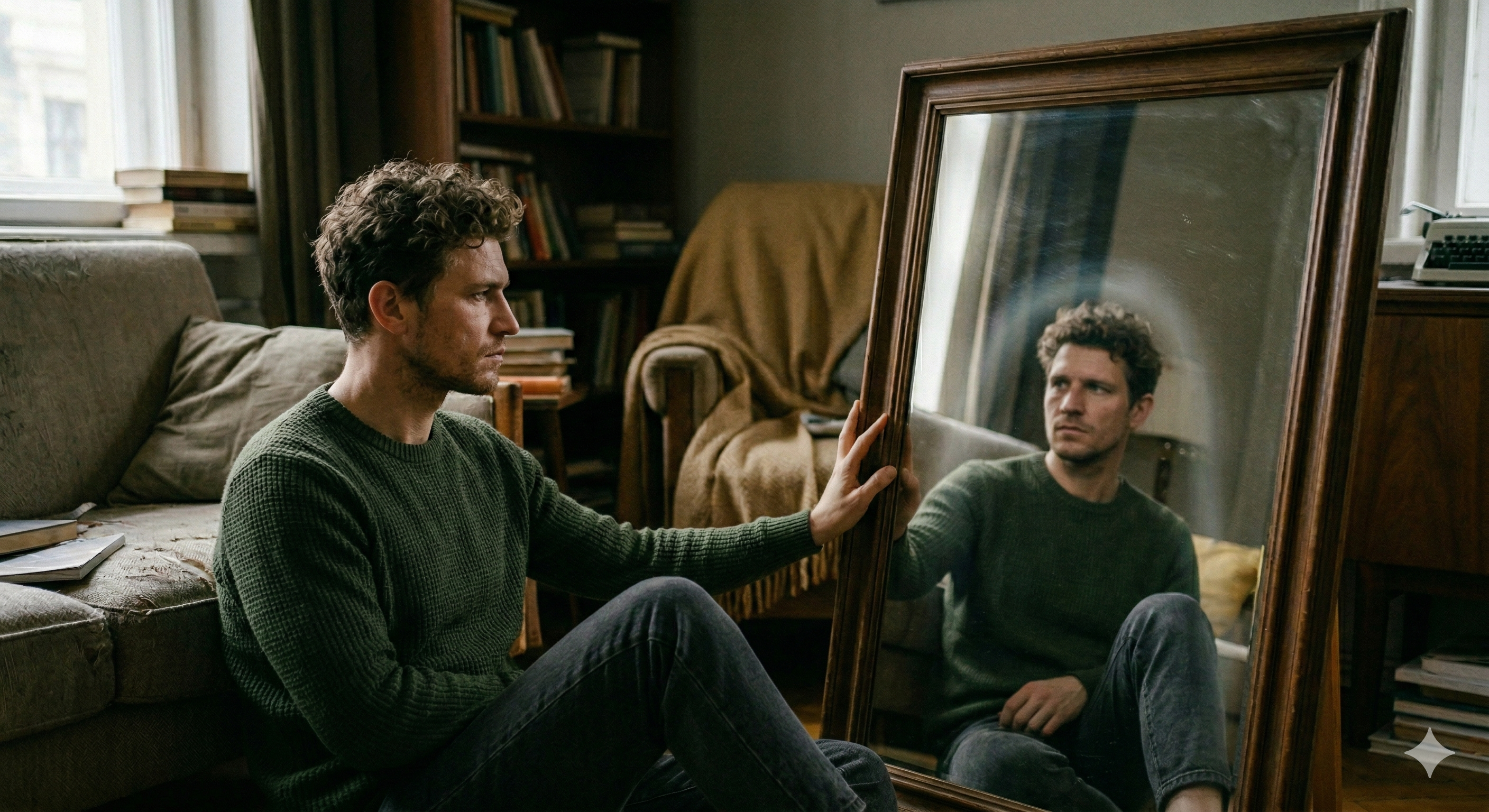
Most of recovery, for me, has been a slow unlearning of the idea that the problem was out there. Out in the bottle. Out in the people who didn’t understand. Out in the bad years, the bad luck, the bad timing. Today’s reflection drags that whole story into the light and asks the question I spent most of my drinking life avoiding: what if the thing I’ve been running from this whole time is me?
The Twelve and Twelve uses a phrase I used to actively dislike — “emotional deformities.” It sounded harsh when I first heard it. Almost mean. I wanted softer language, the kind that let me keep one foot out the door. Stress. A rough patch. A phase. Anything that suggested the bend in me was temporary, situational, somebody else’s fault. But softer language was part of how I stayed sick. The Twelve and Twelve doesn’t hand you an exit. It sits you down and says: something inside you got warped, and pretending it didn’t isn’t going to straighten it.
Here’s what nobody told me in the beginning, and what I wish someone had: the drinking was never really about the drinking. The drinking was a way of not being in the room with myself. Every pour was a small exit. Every buzz was a tiny vacation from a person I couldn’t stand to sit quietly with. And the longer you avoid that person, the more dangerous the eventual meeting starts to feel. By the end, the prospect of just being — sober, still, honest, alone with my own head — was scarier than any of the things I was actively doing to my body to avoid it.
The part of the reflection I want to sit with, though, is the part about dreams. The writer says they can’t exist without dreams, that dreams are what keep them moving — but that even dreams can become a cage. That hit something in me I don’t usually talk about. Because the secret nobody warns you about is that getting sober doesn’t kill the disease. It just makes it clever. It moves into other rooms. It finds the things you love and the things you want and starts whispering the same old script in a brand-new voice. More. Faster. Prove it. Earn it. You’re behind. Same hunger. Different costume.
I’d dreamed it more times than I can count — woken up convinced of it, the way you wake up convinced of things at four in the morning. One night the answer was to turn my recovery into a personality. Another night it was my work. Another, my health. And once, almost funny in hindsight, it was growth itself — the project of becoming a better person, white-knuckled into one more thing to chase. None of those dreams ever quite became plans. But the fact that my mind kept reaching for them told me everything I needed to know. The instinct to flee myself didn’t die when I put down the drink. It just learned new languages in my sleep. Some of them sounded like wisdom. Some sounded like ambition. A few sounded suspiciously like the program.
So what does an “inside look” actually mean, in practice, years down the road? For me it’s a lot less dramatic than it sounds. It’s not a confrontation. It’s not a dark night of the soul I schedule for Tuesday. It’s catching myself in the act — noticing when I’m reaching for anything to avoid what I’m actually feeling. Noticing when a so-called dream is really just a hiding place with better lighting. Noticing when I’m being hard on myself in a way that wears the costume of growth but is really the old self-hatred in a clean shirt. The looking is the work. And it has to happen daily, because the self I’m trying to meet doesn’t keep an appointment book. He shows up in the irritation I didn’t expect. The resentment I swore I was over. The fear I dressed up as an opinion so I wouldn’t have to call it fear.
The line about asking God’s power to face the true me reads differently to me now than it did at the start. Early on, I imagined it as a single big reckoning — sit down, have it out, settle the matter. Now I understand it’s not one meeting. It’s a thousand small ones. It’s a willingness, repeated daily, to not flinch when I see something I don’t like. And the higher power piece isn’t in there because the looking is impossible without it. It’s in there because the looking is unbearable without it. There has to be something on the other side of what you find, or you stop looking. That’s what grace is for. It’s the thing that makes the truth survivable.
Here’s what I know now that I didn’t know then. The person I was so afraid to meet wasn’t a monster. He was a man who’d been carrying a lot, alone, for a long time, and had never given himself permission to set any of it down. The drinking was the only way I’d ever found to stop performing. When I finally started looking inside without a drink in my hand, what I found wasn’t the worst version of me. It was the most honest one. And honest is something you can actually build a life on. Performance isn’t.
The freedom the reflection ends on — that’s not a metaphor. It’s a real thing, and it’s available, and I’ve felt it. Not constantly. Not even most of the time. But often enough to know the door is real. It opens the moment you stop running, even for a breath. It’s the quiet, almost embarrassing relief of being in a room with yourself and not needing to leave.
That, for me, is what sobriety actually turned out to be. Not the absence of a drink. The presence of a person.
And most days now, I’m glad he stuck around.
Two things from my own walk through this work, in case they’re useful. I put together a recovery journal on Amazon built around small daily prompts — the kind of looking-inward this step asks for, in doses you can actually swallow. And MyRecoveryPal is something I built for the in-between hours, when you need a steadier place to land between meetings. Neither one replaces the rooms or the work. They’re just things I made because I needed them.
Comments (0)
Login to leave a comment.
No comments yet. Be the first to share your thoughts!