Resentment didn’t feel like bondage. It felt like the floor I was standing on. Turns out it was both.
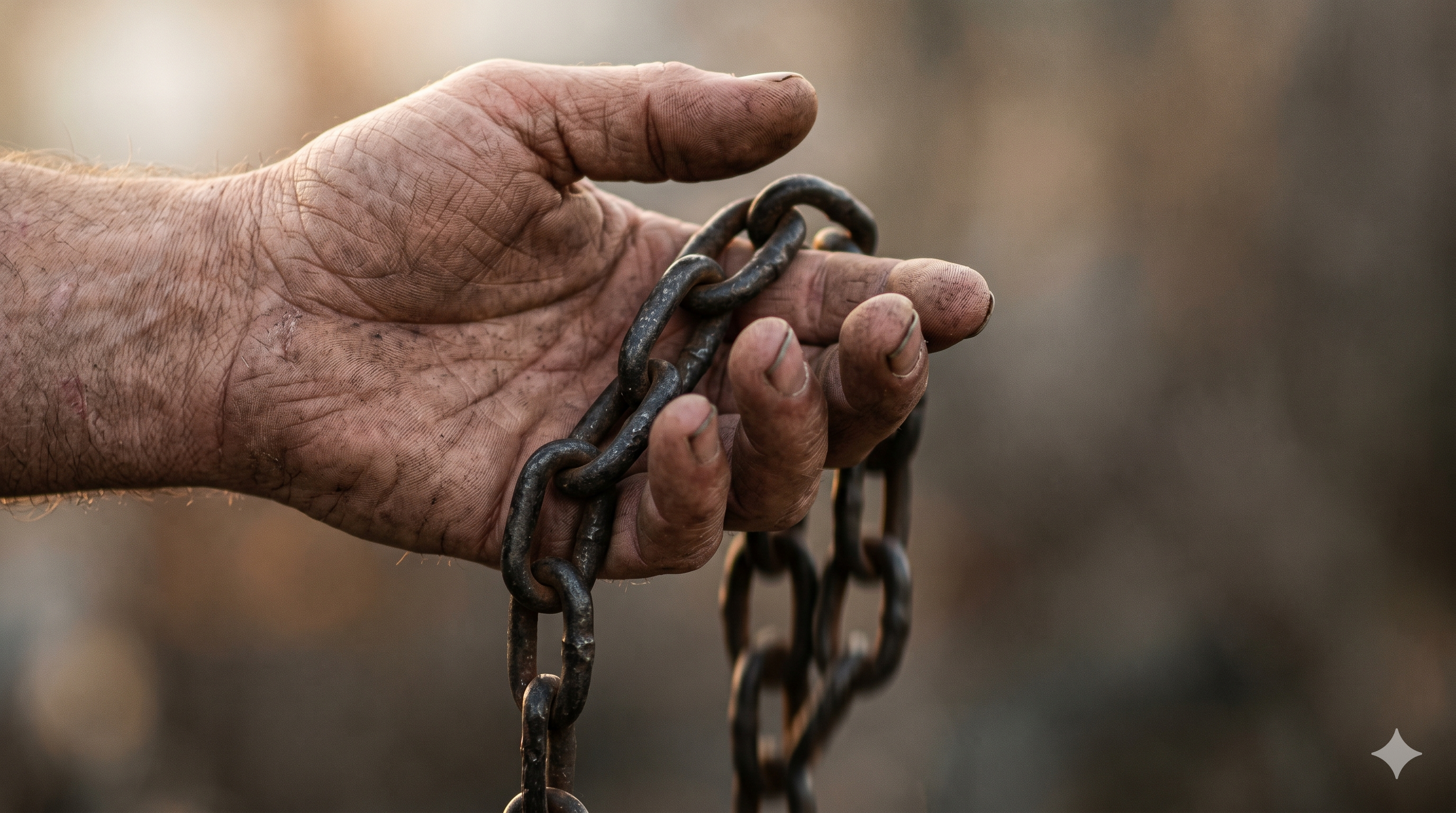
Bondage implies chains. It implies captivity. It implies that you are not free and something is holding you in place. But resentment doesn’t work like that. Nobody chains you to a resentment. Nobody forces you to carry one. You pick it up yourself, and then you choose it again every single morning without ever noticing you’re choosing. The prisoner is also the guard. The chain is one you’re holding with your own hand, and you’ve been gripping it so long your fingers have forgotten how to open.
I lived in that grip for years before sobriety, and I didn’t know it. My resentments weren’t dramatic. They were atmospheric — the low hum underneath everything, the quiet assumption that life had been unfair, that people had let me down in ways I couldn’t quite name. I didn’t walk around seething. I walked around braced. Braced for the next disappointment, the next letdown, the next confirmation that people couldn’t be trusted to show up the way I needed them to. That brace was the chain. And because it had been there so long, I mistook it for my skeleton.
THE BONDAGE OF RESENTMENTS April 15
“. . . harboring resentment is infinitely grave. For then we shut ourselves off from the sunlight of the spirit.” — AS BILL SEES IT, p. 5
It has been said, “Anger is a luxury I cannot afford.” Does this suggest I ignore this human emotion? I believe not. Before I learned of the A.A. program, I was a slave to the behavior patterns of alcoholism. I was chained to negativity, with no hope of cutting loose. The Steps offered me an alternative. Step Four was the beginning of the end of my bondage. The process of “letting go” started with an inventory. I needed not be frightened, for the previous Steps assured me I was not alone. My Higher Power led me to this door and gave me the gift of choice. Today I can choose to open the door to freedom and rejoice in the sunlight of the Steps, as they cleanse the spirit within me.
Today’s reflection asks a question I appreciate: does “anger is a luxury I cannot afford” mean we ignore the emotion entirely? The writer answers no, and I agree. Anger is legitimate. It signals a boundary crossed, a need unmet. The problem isn’t the anger. The problem is what happens when anger moves in and starts calling itself something else. When anger becomes resentment, it stops being a signal and becomes a residence. And once you’re living inside it, every other emotion has to pass through it on the way in — joy arrives filtered, love arrives guarded, and peace never quite makes it through the door.
Step Four was the first time I saw the chain for what it was. Writing the inventory was like turning a light on in a room I’d been stumbling through in the dark. Almost all of my resentments traced back to unspoken expectations — things I’d needed from people and never asked for, things I’d given hoping to receive something in return, silent contracts nobody else knew about. I’d spent years believing other people were the source of my disappointment. The inventory showed me I was the architect.
What today’s reflection gets right is the emphasis on choice. Before the Steps, I didn’t know I had one. Resentment felt like weather — something that happened to me, something I endured. The program didn’t change the weather. It taught me I could walk out of the storm. Not by pretending it wasn’t raining. But by doing the actual, written, sponsor-guided work of naming what I was holding, understanding why, and making a conscious decision to set it down. That decision is the gift the reflection is talking about. Not a feeling. Not a breakthrough. A door.
I think about the words of Jesus here — “you will know the truth, and the truth will set you free.” For most of my life, I heard that as a nice proverb. Something you’d stitch on a pillow. In recovery, I’ve come to understand it as an instruction manual. The truth — the specific, uncomfortable, written-down-on-paper truth of your own inventory — is what breaks the chain. Not positive thinking. Not willpower. The truth. Your truth. The one you’ve been avoiding because looking at it means you can no longer blame the chain on someone else.
Freedom in recovery doesn’t feel the way I expected it to. I thought it would feel like relief. More often, it feels like responsibility. Because once you know you have a choice, you can’t unknow it. Once you’ve seen the chain in your own hand, you can’t pretend someone else put it there. Every morning after the Fourth Step is a morning where whatever resentment you’re carrying, you’re carrying by choice. And that knowledge — uncomfortable, constant, inescapable — is the most freeing thing I’ve ever encountered. Not because it feels good. Because it means I’m no longer a prisoner who doesn’t know he’s a prisoner. I’m a free man who has to keep choosing freedom, one day at a time, with his eyes open.
These days, resentment still knocks. It’s quieter than it used to be, and I recognize it faster, but it still shows up — usually wearing something reasonable, usually carrying a story that sounds justified. The difference between now and then is that I know the knock for what it is. I can open the door to that old room, walk in, and sit down in the dark again. Or I can turn around, face the light, and do whatever small next thing the program asks of me.
Not the absence of chains. The knowledge that the lock was always in my own hand.
If today’s reflection is sitting with you, two things from my own walk that might help. I put together a recovery journal on Amazon — built around the kind of daily inventory that turns the light on in the room and helps you see what you’ve been carrying. And MyRecoveryPal is something I created for the moments between meetings, when the old grip tightens and you need a steadier place to loosen it. Neither one replaces the program, the sponsor, or the steps. They’re just tools I made because I needed them, and figured I wasn’t the only one.
More Recovery Tools
Free tools to support your recovery journey
Free Sobriety Calculator
Calculate clean time, milestones, money saved, and health benefits. No signup required.
Free Clean Time Calculator
Track NA clean time, key tag milestones, money saved, and recovery benefits. No signup required.
Free Sobriety Medallion Maker
Create a personalized AA-style recovery medallion. 16 styles, free forever, no signup required.
Sobriety Counter App
Track sober days with milestone alerts, daily check-ins, and community support.
Sober Grid Alternative
Free recovery social network. Connect with peers, join groups, and share your journey.
Online AA Meetings
Browse 1,500+ free online AA meetings with join links, updated weekly.
Craving SOS
Guided breathing, urge surfing, and grounding tools for craving moments. Free, no signup.
Relapse Prevention Plan
Free guided template: triggers, warning signs, coping strategies, and emergency steps.
Alcohol Recovery App
Sobriety tracking, recovery groups, AI coach, and peer support for alcohol recovery.
Comments (0)
Login to leave a comment.
No comments yet. Be the first to share your thoughts!