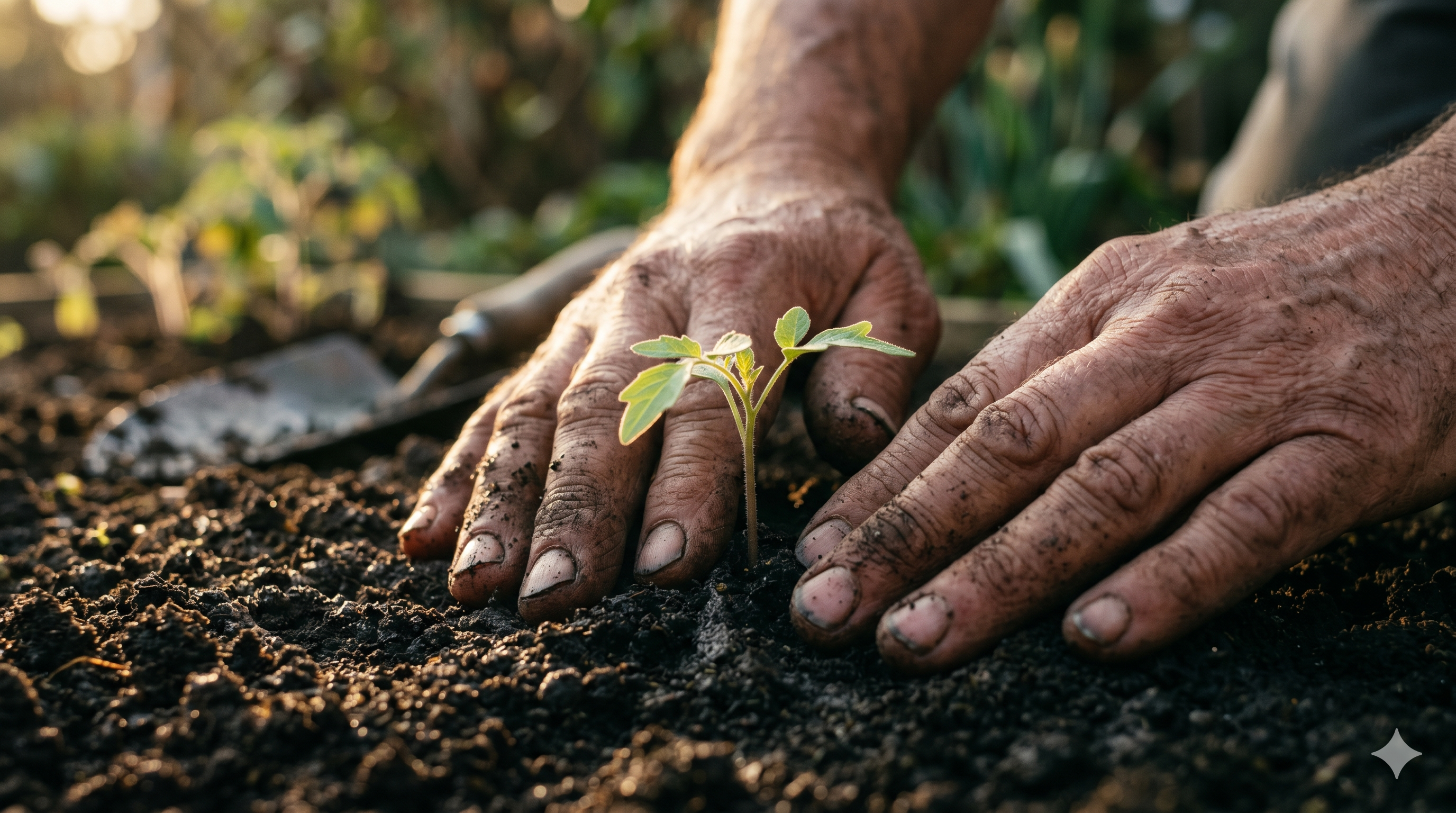
I kept waiting for belief to arrive like a download. Turns out it grows more like a garden — slowly, daily, and only if you show up with dirty hands.
CULTIVATING FAITH April 21
“I don’t think we can do anything very well in this world unless we practice it. And I don’t believe we do A.A. too well unless we practice it. . . . We should practice . . . acquiring the spirit of service. We should attempt to acquire some faith, which isn’t easily done, especially for the person who has always been very materialistic, following the standards of society today. But I think faith can be acquired; it can be acquired slowly; it has to be cultivated. That was not easy for me, and I assume that it is difficult for everyone else. . . .” — DR. BOB AND THE GOOD OLDTIMERS, pp. 307–08
Fear is often the force that prevents me from acquiring and cultivating the power of faith. Fear blocks my appreciation of beauty, tolerance, forgiveness, service, and serenity.
I thought I had faith before I got sober. I had every reason to think so. I was on the worship team at church. I prayed daily. I attended on Sundays. I did my devotions. If you’d handed me a checklist of what a faithful life looked like, I could have ticked every box without breaking a sweat. And I believed it, too — I wasn’t pretending. I would have told you, hand on a Bible, that my faith was real. It just hadn’t been tested yet. And untested faith, I’ve come to learn, is a lot like an untested parachute. You can believe in it all you want. You don’t actually know what you’ve got until you jump.
Sobriety was the jump.
Dr. Bob’s words in today’s reflection are disarming because of how ordinary they are. He doesn’t describe a spiritual awakening. He doesn’t describe a burning bush or a voice from the sky. He says faith has to be cultivated. Practiced. Acquired slowly. He says it wasn’t easy for him, and he assumes it’s difficult for everyone else. That’s one of the co-founders of A.A. admitting — plainly, without drama — that belief didn’t come naturally and had to be worked at like a skill. Reading that years ago gave me permission to admit something I’d been carrying quietly for a long time: I had been doing faith, but I hadn’t been living it. There’s a difference between practicing the motions of belief inside a structure that holds you up and needing belief to be the structure itself.
Before sobriety, my faith had a safety net underneath it. Church gave me the community. The worship team gave me the purpose. The devotions gave me the routine. God was in there somewhere, but He was sharing the room with a lot of other supports, and I never had to find out whether my faith could hold weight on its own. When the drinking finally brought everything else down — when the marriage ended, when the friendships faded, when the version of me I’d been curating couldn’t hold its shape anymore — all those supports fell away, and what I was left with was a faith I’d never once had to lean on without something else propping it up.
That’s when I found out what I actually had. And what I actually had was barely a seed. But it was real. For the first time in my life, my faith wasn’t part of a performance or a routine or a social structure. It was just me, alone, with nothing but the raw belief that this had to get better. No worship team backing me up. No Sunday morning audience. No checklist to prove I was doing it right. Just a man on his knees in a half-empty rental house with nothing left, talking to a God he wasn’t even sure was listening, saying the only honest prayer he’d ever prayed: please let this get better.
That prayer — desperate, stripped of every decoration, ugly and honest — was the beginning of real faith for me. Not the faith I’d been performing. The faith I actually needed to survive.
Dr. Bob uses the word practice, and I want to sit with that, because practice implies repetition without mastery. Practice implies doing something imperfectly and then doing it again and trusting that the repetition itself is producing something you can’t see yet. That’s exactly how faith rebuilt itself in my life. Not as a return to the old structure — I didn’t go back to the worship team and the Sunday routine and the checklist and call it done. It grew differently the second time. Smaller. Quieter. Less visible from the outside. More honest from the inside. The slow accumulation of mornings where I prayed without performing, followed by afternoons where something small went right that I couldn’t take credit for, followed by evenings where I realized I’d gotten through a day without the old thinking running the show. None of those moments felt spiritual on their own. Stacked up over months, they started to form a pattern I couldn’t explain away.
The reflection ends with a line about fear — that fear is the force that prevents the cultivation of faith. That’s where it gets personal for me, because fear and faith occupied the same space in my chest for years, and I didn’t understand they were competing for the same seat.
Fear was my operating system before sobriety. Not the dramatic kind — I wasn’t walking around terrified. It was subtler. Fear of being seen. Fear of being found out. Fear of slowing down long enough for the feelings to catch up. Every decision I made ran through that filter, and the filter’s answer was almost always the same: protect yourself. Close down. Stay small. Don’t need anyone. Don’t trust anything you can’t control. That’s not a life. That’s a bunker. But I’d been in the bunker so long I’d decorated it and called it home. I’d even put a cross on the wall and called it faith.
Real faith asks for the opposite of everything fear demands. Faith says trust what you can’t see. Faith says lean into what you can’t control. Faith says open your hands instead of closing them. Faith says the ground is solid even when you can’t feel it beneath you. Every one of those instructions collided directly with the fear that had been running me for decades. No wonder I’d been performing faith instead of living it. Living it would have meant dismantling the very survival strategy that fear had built for me. Performing it let me keep the bunker and the cross on the wall at the same time.
What finally shifted — gradually, not in a flash — was that the fear stopped delivering on its promises. Fear promised safety, and I got isolation. Fear promised control, and I got rigidity. Fear promised protection, and I got a life so small that even the drinking couldn’t fill it. Meanwhile, the faith I was awkwardly, honestly practicing for the first time — the prayers I meant even when they felt clumsy, the trust I extended with shaking hands, the mornings I showed up to the program even when I couldn’t feel it working — was quietly building something underneath me that felt, for the first time, like actual ground. Not the bunker. Not the performance. Ground.
I still practice faith daily, and I use the word practice on purpose. I haven’t graduated. Some mornings the prayer feels alive. Other mornings it feels like talking to a ceiling. I say it anyway, the same way I’d water a garden whether or not I could see anything pushing through the soil. Dr. Bob said faith has to be cultivated, and cultivation is patient, repetitive work that doesn’t promise a timeline. You plant. You water. You show up again tomorrow. And somewhere in the doing — not in the thinking about doing, not in the performing of doing, but in the actual honest showing up — something takes root that your hands didn’t build and your mind can’t fully explain.
That’s faith. Not the checklist. Not the worship team. Not the Sunday routine. Not the version I could perform with my eyes closed. The version that grew in the dirt after everything else burned away. The version that started with nothing but a desperate prayer in a half-empty rental house and built itself, slowly, into ground I can actually stand on.
Fear still knocks. It probably always will. But the garden is bigger now than the bunker ever was. And that, for today, is enough.
If today’s reflection is sitting with you, two things from my own path. I put together a recovery journal on Amazon — built for the kind of slow, daily cultivation Dr. Bob is describing. Small prompts, honest pages, the quiet repetitive work of showing up to yourself and to God one morning at a time. And MyRecoveryPal is something I created for the in-between hours, when faith feels far away and fear starts filling the gap. Neither one replaces the program or the prayer. They’re just tools I made because I needed them, and figured I wasn’t the only one.
More Recovery Tools
Free tools to support your recovery journey
Free Sobriety Calculator
Calculate clean time, milestones, money saved, and health benefits. No signup required.
Free Clean Time Calculator
Track NA clean time, key tag milestones, money saved, and recovery benefits. No signup required.
Free Sobriety Medallion Maker
Create a personalized AA-style recovery medallion. 16 styles, free forever, no signup required.
Sobriety Counter App
Track sober days with milestone alerts, daily check-ins, and community support.
Sober Grid Alternative
Free recovery social network. Connect with peers, join groups, and share your journey.
Online AA Meetings
Browse 1,500+ free online AA meetings with join links, updated weekly.
Craving SOS
Guided breathing, urge surfing, and grounding tools for craving moments. Free, no signup.
Relapse Prevention Plan
Free guided template: triggers, warning signs, coping strategies, and emergency steps.
Alcohol Recovery App
Sobriety tracking, recovery groups, AI coach, and peer support for alcohol recovery.
Comments (0)
Login to leave a comment.
No comments yet. Be the first to share your thoughts!